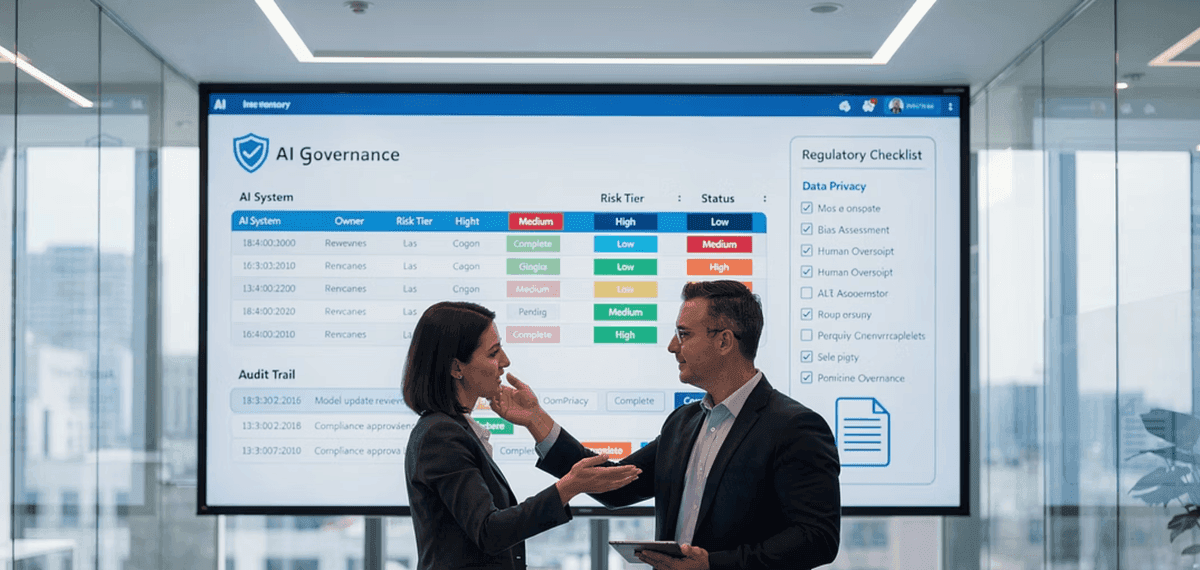
In short: the best AI governance tools in 2026, by our weighted score (scores as of November 2026), are IBM watsonx.governance (4.55/5), Credo AI (4.50), ModelOp (4.05), Saidot (4.00), Holistic AI and OneTrust (3.90 each), ServiceNow AI Control Tower (3.65) and Truyo (3.10). Only IBM publishes list prices. Saidot (Finland) is the only EU-headquartered vendor; Holistic AI is UK-based and the other six are US companies. If your main risk is staff pasting data into ChatGPT or Copilot, you need usage governance (for example Microsoft Purview) before a model governance platform.
Most companies already run more AI than they can list. IBM's Cost of a Data Breach Report 2025 found that 63% of breached organizations either had no AI governance policy or were still developing one, that only 34% of those with a policy audited regularly for unsanctioned AI, and that one in five organizations reported a breach due to shadow AI. That is the gap AI governance tools are built to close: a single inventory of every model, agent and AI vendor, mapped to the rules that apply to it, with evidence an auditor will accept.
The category now has its own analyst coverage. Gartner published its first Magic Quadrant for AI Governance Platforms on 17 June 2026, according to IBM's announcement, and "evaluated 13 vendors based on ability to execute and completeness of vision", according to Holistic AI. Gartner's own definition sets the bar used throughout this guide: "AI governance platforms are designed to centrally define, approve and enforce responsible AI policies" (as quoted by Airia).
We scored eight of those platforms against the same published framework, with an explicit angle for European buyers: the EU AI Act timeline after the AI Omnibus, and ISO/IEC 42001 certification. Product and pricing data were verified on each vendor's official pages in November 2026.
What are AI governance tools, and what problem do they solve?
AI governance tools are platforms that keep a live inventory of an organization's AI systems, classify each one by risk, apply the controls that the relevant regulation or standard demands, and store the evidence that those controls were applied. In practice they replace the spreadsheet-plus-email process most compliance teams start with.
A complete platform covers four jobs:
- Discovery and inventory: finding models, agents, copilots and third-party AI features across clouds, code repositories and SaaS, including the ones nobody registered (shadow AI).
- Risk classification and assessment: deciding whether a use case is prohibited, high-risk, limited-risk or minimal-risk under the EU AI Act, and running impact or risk assessments.
- Controls and workflows: approvals, deployment gates, policy packs and testing (bias, robustness, hallucination) tied to each use case.
- Evidence and monitoring: audit-ready documentation, logs and continuous monitoring after go-live.
What these tools are not: they do not make an AI system compliant by themselves, and they do not replace the legal analysis of whether you are a provider or a deployer. They make governance repeatable and provable. If you are still defining the policies a platform would enforce, start with our AI consulting services before buying software.
AI usage governance vs model governance: which do you need?
Usage governance controls how employees use AI tools such as ChatGPT, Copilot or Gemini; model governance controls the AI systems your organization builds, buys or deploys. Many SMEs need the first one before the second, and the products are different.
| AI usage governance | AI model and system governance | |
|---|---|---|
| Main question | What data are people sending to AI tools? | Which AI systems do we run, how risky are they, and can we prove control? |
| Typical controls | Data loss prevention, sensitivity labels, browser and network inspection, audit of prompts | Inventory, risk classification, approvals, testing, monitoring, evidence |
| Regulatory anchor | GDPR, confidentiality, AI literacy | EU AI Act (Articles 17 and 26), ISO/IEC 42001, NIST AI RMF |
| Example tools | Microsoft Purview, runtime security layers such as Airia | The eight platforms scored below |
Microsoft documents that Purview can audit Copilot prompts and responses, apply sensitivity labels and data loss prevention to them, and block users from pasting sensitive data into third-party generative AI sites such as ChatGPT from onboarded Windows devices. That covers usage, not a register of high-risk AI systems. Most mid-sized companies end up with both layers.
How we scored the best AI governance platforms: our evaluation framework
Every platform was scored from 1 to 5 on six criteria. The weighted score (maximum 5.00) decides the ranking; where two tools tie, the higher lifecycle-controls score breaks the tie, and we say so.
| Criterion | Weight | What we assessed |
|---|---|---|
| Regulatory coverage | 25% | Ready-made content for the EU AI Act, ISO/IEC 42001 and NIST AI RMF, verified on the vendor's own pages |
| Inventory and discovery | 20% | Automated discovery of models, agents and shadow AI; dependency mapping |
| Lifecycle controls and evidence | 20% | Assessments, approvals, testing, monitoring and audit-ready evidence |
| Integration and ecosystem | 15% | Documented connectors to clouds, ML platforms, ticketing and GRC tools |
| Pricing transparency | 10% | Whether list prices or the pricing model are published on the official site |
| EU fit | 10% | 5 = EU headquarters; 4 = EU hosting region or on-premises option documented on official pages; 3 = EU AI Act content only |
Four principles behind the framework:
- Regulatory coverage weighs most (25%) because the main reason a European company buys a governance platform in 2026 is to prove compliance with the AI Act and to prepare for ISO/IEC 42001 certification.
- We score only what is documented. If a framework or feature is not on the vendor's official pages, it does not earn points, even if a sales deck promises it.
- Pricing transparency is scored, not price. Only one of the eight vendors publishes list prices; the rest sell by quote, which matters when you need a figure before talking to sales.
- This is desk research, not a lab test. We did not run hands-on trials of the eight products. Scores reflect public documentation, so the proof-of-concept checklist later in this guide is where your own testing should start.
Inclusion criterion. We started from the vendors that publicly announced a placement in the Gartner 2026 Magic Quadrant, added two specialists with strong documented framework content (Credo AI, a Leader in the Forrester Wave Q3 2025, and Saidot, the EU-based option), and kept those that document a cross-platform AI inventory plus content for at least two of the three main frameworks (EU AI Act, ISO/IEC 42001, NIST AI RMF). Seven products we reviewed but did not score are listed, with the reason, under "Also considered", followed by the main open-source options.
About the Gartner placements. Gartner's report sits behind a paywall, so we state a placement only when the vendor itself announced it, and we link that announcement in each section. We found no public placement announcement from Credo AI or Saidot, so their Gartner cell reads "not announced". Analyst placement informed our research but did not set our scores.
The 8 best AI governance tools in 2026, compared and scored
IBM watsonx.governance ranks first with 4.55/5, thanks to the broadest documented regulatory content and the only public price list; Credo AI follows at 4.50 with the strongest pure-play feature set, and ModelOp is third at 4.05 for lifecycle automation in large model portfolios.
Scores and Gartner placements as of November 2026.
| # | Platform | HQ | Score | Best for | Gartner MQ 2026 | Frameworks documented | Pricing |
|---|---|---|---|---|---|---|---|
| 1 | IBM watsonx.governance | US | 4.55 | Broad regulatory content with a public price list | Leader | EU AI Act, ISO 42001, NIST AI RMF | Public, from $3,500/month |
| 2 | Credo AI | US | 4.50 | Policy packs and agent registry in regulated enterprises | Not announced | EU AI Act, ISO 42001, NIST AI RMF | Quote only |
| 3 | ModelOp | US | 4.05 | Large ML, GenAI and agent portfolios | Visionary | EU AI Act, ISO 42001, NIST AI RMF, SR 11-7 | Quote only |
| 4 | Saidot | Finland (EU) | 4.00 | European buyers who want an EU vendor | Not announced | EU AI Act, ISO 42001, NIST AI RMF | Quote only |
| 5 | Holistic AI | UK | 3.90 | Testing, red teaming and model assurance | Challenger | EU AI Act, ISO 42001, NIST AI RMF | Quote only |
| 6 | OneTrust AI Governance | US | 3.90 | Companies already on OneTrust for privacy | Visionary | EU AI Act, ISO 42001, NIST AI RMF | Quote only (model published) |
| 7 | ServiceNow AI Control Tower | US | 3.65 | Companies whose CMDB lives in ServiceNow | Leader | EU AI Act, NIST AI RMF (ISO 42001 in review) | Quote only |
| 8 | Truyo | US | 3.10 | Privacy teams needing discovery and de-identification | Leader | EU AI Act, NIST AI RMF | Quote only |
Full criterion scores as of November 2026 (Reg. = regulatory coverage, Inv. = inventory, Life. = lifecycle controls, Int. = integration, Price = pricing transparency, EU = EU fit):
| Platform | Reg. | Inv. | Life. | Int. | Price | EU | Weighted |
|---|---|---|---|---|---|---|---|
| IBM watsonx.governance | 5 | 4 | 5 | 4 | 5 | 4 | 4.55 |
| Credo AI | 5 | 5 | 5 | 5 | 2 | 3 | 4.50 |
| ModelOp | 4 | 4 | 5 | 5 | 2 | 3 | 4.05 |
| Saidot | 5 | 4 | 4 | 3 | 2 | 5 | 4.00 |
| Holistic AI | 4 | 4 | 5 | 4 | 2 | 3 | 3.90 |
| OneTrust AI Governance | 4 | 4 | 4 | 4 | 3 | 4 | 3.90 |
| ServiceNow AI Control Tower | 3 | 5 | 4 | 4 | 2 | 3 | 3.65 |
| Truyo | 3 | 4 | 3 | 3 | 2 | 3 | 3.10 |
Holistic AI and OneTrust tie at 3.90; Holistic AI ranks fifth on the lifecycle-controls tie-break (5 vs 4). The gap between IBM and Credo AI (0.05) comes entirely from EU fit and pricing: IBM documents EU hosting and an on-premises option and publishes prices, while Credo AI documents neither on its own pages. Swap those two criteria out and Credo AI would rank first.
1. IBM watsonx.governance: the most complete platform with public pricing (4.55/5)
IBM watsonx.governance is the only platform in this list that publishes list prices, and it pairs that with the broadest documented regulatory content. IBM's product page lists regulatory and risk content for the EU AI Act, NIST AI RMF and ISO 42001, plus a governance graph, shadow AI detection, continuous monitoring and policy enforcement, with deployment in cloud and on-premises environments. IBM was named a Leader in the Gartner 2026 Magic Quadrant, according to IBM's announcement.
Its EU fit score of 4 rests on two documented facts: IBM's regional availability page lists Frankfurt among the regions for watsonx.governance on both IBM Cloud and AWS, and the Advanced edition is sold as enterprise software for self-managed deployment. Remember that a US vendor stays subject to US law even when data sits in Frankfurt.
Pricing, verified November 2026 on the official pricing page: a free 14-day trial in a shared environment; Model Management on IBM Cloud, pay-as-you-go after a 30-day trial, with a starting price whose billing unit IBM does not publish; Risk & Compliance Basic on IBM Cloud from $3,500 per month (one instance, one module, one concurrent user; add-ons up to a maximum of 25 concurrent users); Risk & Compliance Advanced, sold as enterprise software, from $6,450 per month (up to 200 concurrent users); and an AWS Marketplace plan "starting at $42,000" with one instance, five AI use cases, 12,000 evaluations and 25 concurrent users (the page does not state the contract period). Self-managed software is priced by virtual processor cores. IBM notes that prices are indicative and vary by country.
Where it falls short: per-concurrent-user pricing climbs quickly if many business owners need to fill in assessments, so price the add-ons before the pilot ends.
2. Credo AI: the policy-pack specialist for regulated enterprises (4.50/5)
Credo AI is the strongest pure-play governance platform, missing first place only on pricing transparency and EU fit. Its website documents an agent registry with agent cards, shadow AI detection, risk classification, dependency mapping, a risk and control library built for agentic risks such as tool misuse and scope drift, and ready-to-deploy policy packs for the EU AI Act, NIST AI RMF and ISO 42001. Native integrations include Snowflake, Databricks, AWS, Azure, ServiceNow, Jira, Confluence, Slack, GitHub and MLflow.
Credo AI was named a Leader in The Forrester Wave: AI Governance Solutions, Q3 2025, with the highest possible score in 12 criteria, including AI policy management and AI regulatory compliance audit. We found no public Credo AI announcement of its Gartner 2026 placement.
Watch out for: no public pricing and no EU hosting documented on its own pages. Ask for both in writing during the first call.
3. ModelOp: lifecycle automation for large AI portfolios (4.05/5)
ModelOp suits organizations that already run hundreds of models and need governance embedded in delivery rather than added on top. Its website describes a portfolio inventory covering ML, generative AI, agentic and vendor AI; lifecycle automation from idea to production; governance controls embedded in workflows; and visibility into cost, tokens, risk and ROI. It lists integration with more than 50 technologies and support for the EU AI Act, ISO/IEC 42001, NIST AI RMF and SR 11-7, the US model risk guidance that banks know well.
ModelOp was named a Visionary in the Gartner 2026 Magic Quadrant, according to its June 2026 announcement, which also reports a 3.97/5 score in the AI Agent Governance use case, tied with IBM.
The trade-off: it is built for model-heavy enterprises; a company with a dozen AI use cases will pay for capability it does not use.
4. Saidot: the European, agent-first option (4.00/5)
Saidot is the pick for European buyers who want a vendor that lives under the same regulation they do. The company is based in Helsinki, Finland, according to its pricing page, and its website describes a governance knowledge graph with more than 260 risks, 620 controls, 110 policies and 170 third-party AI models, with curated content for the EU AI Act, ISO/IEC 42001 and NIST AI RMF. It connects agents, systems, models and datasets in one inventory, tracks inherited risks from the models an agent uses, and connects to Azure AI Foundry, Amazon Bedrock and other platforms through REST APIs that, it says, operate 95% of its functionality. It also offers MCP servers so you can connect your own AI assistants and agents to the platform. Saidot states it is ISO/IEC 27001:2022 certified.
Why integration stays at 3: the API and MCP coverage is broad, but connecting Saidot to your stack is largely build work on your side, while Credo AI names ten native integrations and ModelOp more than 50. Prices are not shown on the pricing page.
5. Holistic AI: testing and red teaming built in (3.90/5)
Holistic AI stands out for technical assurance. Its website describes discovery across cloud, code and SaaS with more than 20 integrations, red teaming for prompt injection and jailbreaks, over 40 tests for bias, hallucination, privacy and robustness, and controls mapped to the EU AI Act, NIST AI RMF and ISO/IEC 42001. Its "Guardian Agents" supervise autonomous agents in real time and can block, redirect or escalate actions.
According to its Gartner announcement, Holistic AI was named a Challenger in the 2026 Magic Quadrant and ranked first in the companion Critical Capabilities report for the AI Risk and Compliance use case (3.90/5), and in the top three for AI Agent Governance.
The catch: no public pricing, and the testing depth is wasted if your main need is a policy register rather than model assurance.
6. OneTrust AI Governance: the natural choice if you already run OneTrust (3.90/5)
OneTrust extends a privacy and GRC platform that many European DPOs already use. Its AI Governance page describes continuous AI discovery, consistent risk evaluation across in-house and third-party AI, automated risk tiering for the EU AI Act, NIST AI RMF and ISO 42001, monitoring of models and agents across Amazon Bedrock and Microsoft Foundry, and connectors for Google Vertex, Databricks Unity Catalog, Jira and Palo Alto Networks. OneTrust was named a Visionary in the Gartner 2026 Magic Quadrant, according to the same page.
OneTrust earns an extra pricing point because its pricing page discloses the model: admin users and AI inventory, by quote. It earns an EU fit of 4 because its hosting documentation offers hosting in Germany and France, among other locations.
Keep in mind: outside an existing OneTrust estate, the platform is a large purchase for an AI-only need.
7. ServiceNow AI Control Tower: best when ServiceNow already runs IT (3.65/5)
ServiceNow is the strongest option for inventory if your CMDB already lives there. On 15 October 2026 ServiceNow, which now presents itself as "the Super Intelligence Control Tower for business reinvention", announced AI Passport, which gives "runtime control over what AI agents and Model Context Protocol (MCP) servers are authorized to do", plus shadow AI detection, AI cost management and a kill switch; AI Passport, shadow AI detection and cost management are scheduled for Q4 2026. The June 2026 release notes had added discovery connectors for Databricks, Snowflake and Hugging Face and pre-built compliance packs for the EU AI Act and the California and Colorado AI laws, while ISO 42001 content was described as "currently in legal review". ServiceNow reports it was named a Leader in the Gartner 2026 Magic Quadrant on its Gartner report page.
Where it falls short: the ISO 42001 regulatory content was not yet released at the time of those notes, which costs it points under our weights.
8. Truyo: privacy-first discovery and de-identification (3.10/5)
Truyo is a Gartner Leader that ranks last here because our framework rewards documented framework content most. Its Gartner page confirms the Leader placement, and its AI governance page describes scanning to discover AI usage, an AI inventory, use-case assessments, coverage of the EU AI Act and NIST AI RMF, bias testing and "Scramble", which produces de-identified datasets for training and testing models. ISO/IEC 42001 is not mentioned on those pages.
Watch out for: thin documented ISO 42001 and agent content. The strength: a privacy team that needs AI discovery and data de-identification in one tool.
Agent governance: which platforms cover AI agents and MCP servers?
Agent governance is now the fastest-moving criterion, so we tracked it separately rather than folding it into the weights. In Gartner's companion Critical Capabilities report, ModelOp reports a score of 3.97/5 in the AI Agent Governance use case, which it says was the highest (tied), and Holistic AI says it placed in the top three for that use case.
| Platform | Documented agent governance |
|---|---|
| IBM watsonx.governance | Agent-specific controls not detailed on the product page we reviewed; ask for a demo of agent inventory and monitoring |
| Credo AI | Agent registry with agent cards; risk library for tool misuse and scope drift |
| ModelOp | 3.97/5 for AI Agent Governance in Critical Capabilities (vendor-reported); agentic AI in the portfolio inventory |
| Saidot | Agents, models and datasets in one inventory; inherited risks from underlying models; MCP servers to connect your own assistants and agents |
| Holistic AI | "Guardian Agents" that block, redirect or escalate agent actions; top three in the agent use case |
| OneTrust | Monitoring of models and agents across Amazon Bedrock and Microsoft Foundry |
| ServiceNow | AI Passport with runtime control over what agents and MCP servers may do, kill switch (several features due Q4 2026) |
| Truyo | No agent-specific controls documented on the pages we reviewed |
Also considered: why Airia, Monitaur, Microsoft Purview and others are not in the top 8
We reviewed seven more products and left them out of the scoring for the reasons below, not because they are weak.
| Tool | Status | Why it is not scored here |
|---|---|---|
| Airia | Gartner Visionary; first in the AI Security use case of Critical Capabilities, per Airia | Security and runtime enforcement first (guardrails, agent constraints, red teaming); a strong usage and runtime layer, but our framework weights the compliance register |
| Monitaur | Gartner Visionary; Forrester "Customer Favorite", per Monitaur | Deliberately focused on insurance and other regulated sectors; worth a shortlist slot if that is your industry |
| Cranium AI, Relyance AI | Security-led (Cranium) and privacy-led (Relyance) options | Not scored in this round; check them if they already sit in your security or privacy stack |
| SAP AI Agent Hub | SAP agent management | Scope tied to SAP landscapes; relevant mainly for SAP-centric companies |
| Microsoft Purview | Not in the MQ | Usage and data governance for Copilot and AI apps, not a register of high-risk AI systems (see the section above) |
| Collibra AI Command Center | Not in the MQ | A data-catalog-led option with a unified registry of use cases, models and agents and EU AI Act and NIST AI RMF templates, per Collibra; best for companies that already run Collibra |
Open-source and free options. Free tools exist, but none matches the commercial platforms on automated discovery and connectors. What each one covers:
| Tool | Licence | What it covers |
|---|---|---|
| VerifyWise | Source-available (free for non-commercial and public-sector use; commercial licence for companies) | Self-hosted AI governance platform: model inventory, use-case risk assessment, vendor risk, incidents, with EU AI Act, ISO/IEC 42001 and NIST AI RMF mappings |
| IBM AI Fairness 360 | Apache 2.0 | Fairness metrics and bias-mitigation algorithms for datasets and models |
| Fairlearn | Open source | Fairness assessment and mitigation for data scientists |
| Giskard | Apache 2.0 | Testing of LLM agents: prompt injection, jailbreaks, hallucination, RAG quality, red teaming |
| MLflow Model Registry | Open source | Model versions, lineage to training runs and aliases: a technical inventory, not a compliance register |
The testing libraries produce evidence; VerifyWise is the closest to a register. Add the free NIST AI RMF, the AI Act text and IBM's 14-day trial, and a small team can build a first inventory before paying for a licence.
How do AI governance tools map to the EU AI Act and ISO 42001?
AI governance tools map to the EU AI Act by turning its obligations into tracked records, and to ISO/IEC 42001 by running the management system the standard requires. In framework terms, the AI Act is law, ISO/IEC 42001 is a voluntary, certifiable standard, and the NIST AI RMF is a voluntary risk framework; a good platform maps one inventory to all three.
On the law, the deadlines moved in 2026. The European Commission's AI Act page states that, after the AI Omnibus amendments entered into force on 27 July 2026, rules for high-risk areas listed in Annex III apply from 2 December 2027, and rules for AI built into regulated products apply from 2 August 2028. Prohibitions 1 to 8 and the AI literacy duty have applied since 2 February 2025, a ninth prohibition (AI that generates non-consensual intimate content or child sexual abuse material) comes into effect in December 2026, and the Commission lists the transparency rules as coming into effect in August 2026. For the full obligations by role, see our EU AI Act compliance guide.
On the standard, ISO/IEC 42001:2023 was published on 18 December 2023 and specifies requirements for establishing, implementing, maintaining and continually improving an AI management system. The NIST AI RMF, released on 26 January 2023, is voluntary and organized around four functions: Govern, Map, Measure and Manage.
| Obligation | Source | What a governance platform should give you |
|---|---|---|
| Quality management system for high-risk AI providers | AI Act, Article 17 | Documented processes, risk management, post-market monitoring and incident records |
| Human oversight and log retention for deployers (logs kept at least six months) | AI Act, Article 26 | Named owners per system, oversight workflows, log retention evidence |
| AI management system and controls | ISO/IEC 42001:2023 | Policy register, risk treatment, internal audit trail |
| Risk management functions | NIST AI RMF 1.0 | Mapping of use cases to Govern, Map, Measure, Manage |
For the certification route itself, see our guide to ISO 42001 certification; for the overlap between personal data and AI obligations, see our GDPR and AI Act compliance guide.
"The delay to December 2027 is not a reason to wait. It is roughly a year to build the inventory, because a governance platform can only govern the AI systems you have already found." — Alfons Marques, founder of Technova Partners
How much does AI governance software cost?
Only IBM publishes list prices among the eight platforms reviewed, so most budgets start from a sales quote. Verified November 2026 on the official pages:
| Platform | Published pricing |
|---|---|
| IBM watsonx.governance | Free 14-day trial; Model Management pay-as-you-go (billing unit not published by IBM); Risk & Compliance Basic (IBM Cloud) from $3,500/month, up to 25 concurrent users with add-ons; Advanced (enterprise software) from $6,450/month, up to 200 concurrent users; AWS Marketplace from $42,000 (5 use cases, 12,000 evaluations, 25 concurrent users; period not stated) |
| OneTrust AI Governance | Quote only; priced on admin users and AI inventory |
| Credo AI, ModelOp, Saidot, Holistic AI, ServiceNow, Truyo | Quote only; no prices on the official site |
Three cost drivers apply whichever vendor you pick:
- Unit of pricing. Concurrent users (IBM), admin users plus inventory size (OneTrust) or use cases all scale differently. Model the next two years, not the pilot.
- Implementation. Building the inventory and adapting policy packs to your organization takes internal time that no subscription covers.
- Overlap. If you already license a GRC, privacy, data catalog or ITSM suite that offers an AI module, compare the add-on before buying a stand-alone tool.
How to choose an AI governance tool for your organization
Choose by starting from the system you already run, then filter by the framework you need to prove and by whether your risk sits in usage or in the models themselves.
| Your situation | Test first | Why |
|---|---|---|
| Main risk is staff using ChatGPT or Copilot with company data | Microsoft Purview or a runtime layer such as Airia | Usage governance comes before a model register |
| You already run OneTrust for privacy | OneTrust AI Governance | Reuses inventory, workflows and DPO processes |
| Your CMDB and IT workflows live in ServiceNow | ServiceNow AI Control Tower | Inventory and ownership already exist there |
| You need ISO/IEC 42001 certification | IBM, Credo AI, ModelOp, Saidot, Holistic AI or OneTrust | ISO 42001 content is documented today |
| You build and run many models or agents | ModelOp, Credo AI or Holistic AI | Deepest lifecycle, agent risk and testing controls |
| You want an EU-headquartered vendor | Saidot | Helsinki-based (Holistic AI is in the UK, outside the EU); ask every vendor where evidence is stored |
| You need a budget figure before talking to sales | IBM watsonx.governance | The only public price list |
For data residency, ask every vendor in writing where inventory data and evidence are stored. Our data protection and GDPR services cover this assessment.
What to test in a 30-day proof of concept
A sequence that works for most mid-sized companies: build a first inventory in a spreadsheet, classify risk under the AI Act, then run two platforms side by side for 30 days with your real use cases. Five tests separate the platforms quickly:
- Import your inventory and check how many systems are discovered automatically versus entered by hand.
- Classify one high-risk use case end to end and export the resulting evidence pack.
- Register one agent with its tools or MCP servers and check whether inherited model risks appear.
- Run the internal audit view an ISO 42001 auditor would ask for, not just the policy pack.
- Price year two with your real number of users, use cases and evaluations.
Also ask each vendor for its own certificates, not just its templates. OneTrust's trust center lists ISO/IEC 27001, 27701 and 27017 plus SOC 2 Type II, and Saidot states ISO/IEC 27001:2022; neither page we reviewed lists an ISO/IEC 42001 certificate for the vendor itself. A vendor that sells ISO 42001 readiness but has not certified its own AI management system should be able to explain why.
Our data and AI services team runs that process end to end, and if your use cases include autonomous agents, our comparison of enterprise AI agents helps size the inventory.
Conclusion
- IBM watsonx.governance leads our scoring thanks to broad documented regulatory content, documented EU hosting and the only public price list.
- Credo AI is the strongest pure-play platform, with policy packs for the EU AI Act, ISO 42001 and NIST AI RMF, and would rank first if pricing and EU hosting did not count.
- Saidot is the European option; OneTrust and ServiceNow win when you already run their platforms.
- If your exposure is employees using public AI tools, start with usage governance such as Microsoft Purview before a model governance platform.
- The EU AI Act high-risk deadlines moved to December 2027 and August 2028, which gives time to build the inventory, not to skip it. The AI literacy duty already applies, whatever platform you choose.
Need help selecting or rolling out an AI governance platform? Talk to our data and AI team or review our data protection services.
About the author. Alfons Marques is the founder of Technova Partners, a consultancy that helps European companies adopt data and AI, including AI Act readiness and ISO/IEC 42001 programmes. The scores in this guide come only from the vendors' public documentation, using the framework published above.
Frequently Asked Questions
Which AI governance tool should a European company choose?
It depends on your stack more than on the ranking. IBM watsonx.governance fits if you need a budget figure and EU hosting; Saidot if you want an EU-headquartered vendor; OneTrust or ServiceNow if you already run them; Credo AI or ModelOp for large model and agent portfolios.
What is an AI governance framework?
An AI governance framework is the set of policies, roles, risk criteria and controls an organization uses to approve and monitor AI. Most companies build theirs on three references: the EU AI Act (law), ISO/IEC 42001 (certifiable management system) and the NIST AI RMF (Govern, Map, Measure, Manage). A platform enforces the framework; it does not replace it.
How do I implement AI governance in a company?
Start with an inventory of every AI system and tool in use, then classify each by AI Act risk, name an owner, and write the approval and monitoring rules. Train staff on AI literacy, which the AI Act already requires. Only then run a 30-day proof of concept with two platforms on your real use cases.
What is the difference between AI governance and data governance?
Data governance controls the quality, ownership and access of data; AI governance controls the AI systems that use that data, including their risk class, approvals, testing and monitoring. They overlap on training data and privacy, which is why data catalog and privacy vendors such as Collibra and OneTrust now sell AI governance modules.
What features should an AI governance tool have?
At minimum: automated discovery and inventory of models, agents and AI vendors; risk classification against the EU AI Act; assessment and approval workflows; ready-made content for ISO/IEC 42001 and NIST AI RMF; monitoring after go-live; and exportable, audit-ready evidence. In 2026, add agent governance and connectors to your cloud and ML platforms.
Who needs an AI governance platform?
Any organization that deploys high-risk AI under the EU AI Act, seeks ISO/IEC 42001 certification, or runs more AI systems than a spreadsheet can track reliably. Companies with a handful of low-risk use cases can start with documents and add a platform when the inventory or audit workload grows.
Are there free or open-source AI governance tools?
Yes, but none matches the commercial platforms on discovery and connectors. VerifyWise is a source-available governance platform with EU AI Act and ISO 42001 templates (free for non-commercial use); IBM AI Fairness 360, Fairlearn and Giskard cover testing; MLflow covers model registry. IBM also offers a 14-day free trial.
Do AI governance platforms make you compliant with the EU AI Act?
No. They organize and prove compliance: inventory, risk classification, controls and evidence. You still need to decide whether you are a provider or a deployer and which obligations apply. Under the AI Omnibus, Annex III high-risk rules apply from 2 December 2027, according to the European Commission.
How much does an AI governance platform cost?
Only IBM publishes list prices: Risk & Compliance Basic starts at $3,500 per month and Advanced at $6,450 per month, verified November 2026. The other platforms reviewed, including Credo AI, OneTrust and Holistic AI, sell by quote.