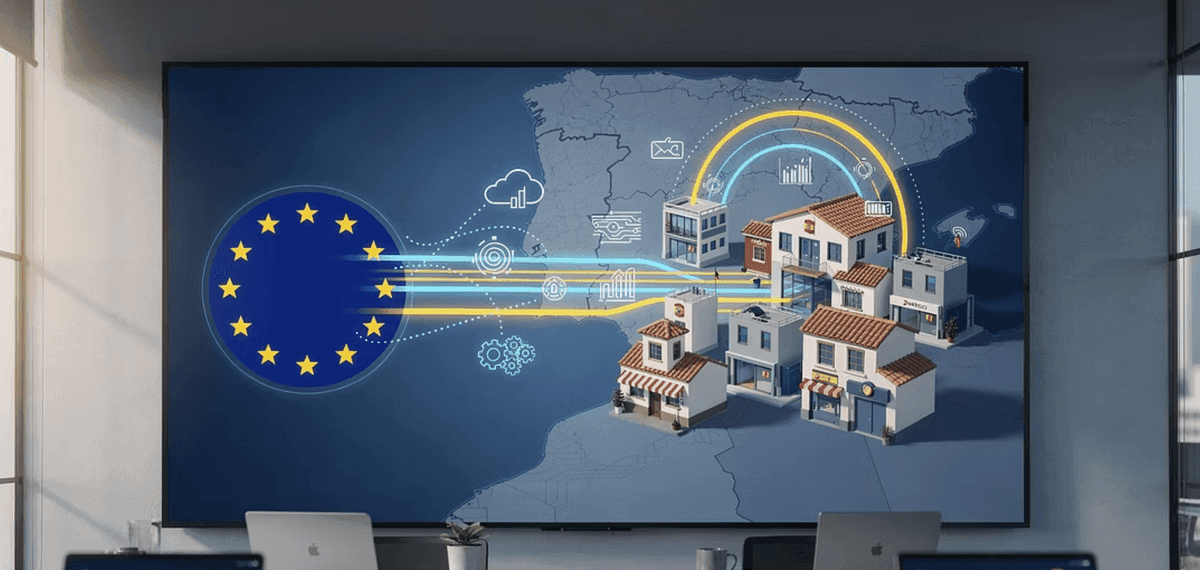
Spanish companies collect payment at an average of 80.5 days — 34% above the legal 60-day ceiling — and that late payment costs each SME around €5,350 per year in commercial debt financing, according to CEPYME's Late Payment Observatory (2025). That is precisely the rationale behind Spain's mandatory e-invoicing under the Ley Crea y Crece (Business Creation and Growth Act): to make every invoice and every payment between businesses fully traceable. The implementing regulation that was missing has now arrived (RD 238/2026, Royal Decree 238/2026), the real calendar points to 2027-2028, and close to 80% of SMEs admit they do not know how to comply. This guide sets the record straight: what it is exactly, when it applies to you, how the AEAT's public platform will work, what penalties exist, and how to prepare once — covering VeriFactu at the same time, since that is a separate but parallel obligation.
What Is Spain's Mandatory E-Invoicing and Who Does It Affect?
Spain's mandatory e-invoicing is the requirement of Article 12 of the Ley Crea y Crece (Law 18/2022) that all transactions between businesses and self-employed professionals established in Spain must be invoiced in a structured electronic format — a data file that systems read automatically, not a PDF. It applies to all Spanish companies and freelancers in their B2B relationships, with no minimum revenue threshold: size only determines when the obligation kicks in, not whether it does. Excluded are sales to end consumers (B2C) and transactions with foreign customers or suppliers. The stated purpose of the regulation is not fiscal but rather combating late payment: each electronic invoice will carry associated acceptance and payment statuses, making it visible who pays late. Today, issuing invoices as PDFs remains perfectly legal — the obligation has not yet begun for anyone.
When Will It Be Mandatory? The Real Calendar as of Today
As of 26 July 2026, no company is yet required to issue B2B electronic invoices. RD 238/2026 (in force since 20 April 2026) established the mechanism: the deadlines begin to run once the ministerial order for the public invoicing platform is published. That order remains a work in progress — its public consultation closed on 8 May 2026, and the Treasury Ministry expects to publish it in the Official State Gazette (BOE) with effect from 1 October 2026. If that plan holds, the calendar looks like this:
| Milestone |
Expected Date |
Who |
| Ministerial order in force + AEAT sandbox |
October 2026 |
Developers and platforms |
| Public platform fully operational |
Before 1 August 2027 |
AEAT |
| Obligation to issue e-invoices |
1 October 2027 |
Companies billing more than €8 million |
| Obligation to issue for all others |
1 October 2028 |
SMEs and self-employed |
| Payment status reporting for recipients billing less than €8 million |
Additional 12 months (voluntary before that) |
SMEs and self-employed |
The honest caveat almost nobody mentions: all the 2027 and 2028 dates depend on the ministerial order being published in October 2026. If it is delayed, everything shifts together. Plan with this calendar, but review it every quarter.
The system rests on three pillars. First, the format: invoices will follow the European semantic standard EN 16931, with four accepted syntaxes — Facturae, UBL, CII, and EDIFACT. Second, the Public E-Invoicing Platform (SPFE) managed by the AEAT (Spanish Tax Agency): a free issuance and reception platform designed for SMEs and self-employed professionals that will also serve as a universal repository for all B2B invoices in Spain. Third, the obligation for companies using private platforms to send the AEAT's SPFE a faithful electronic copy of each invoice in UBL syntax, at the exact moment of issuance — a detail from the draft ministerial order that corrects the widespread belief that the copy would be in Facturae format. Invoices must remain accessible to the recipient — searchable, downloadable, and printable — for four years, even if the commercial relationship ends. For businesses already invoicing through an ERP or e-invoicing platform, the change will be an adaptation; for those invoicing in Word or PDF, it will be a complete process overhaul.
The Hidden Side Nobody Explains: Receiving Invoices and Reporting Status Within 4 Days
The first date that will truly affect an SME is not the issuance date — it is the reception date. From 1 October 2027, your largest suppliers — telecoms, energy companies, wholesalers — will send you structured electronic invoices, and you will need to be able to process them even if your own issuance obligation does not arrive until a year later. With that comes the duty to communicate status: commercial acceptance or rejection and full effective payment, within 4 business days (excluding Saturdays, Sundays, and national public holidays). Recipients billing less than €8 million have an additional 12 months before that duty becomes enforceable — voluntary until then — but the underlying message of the law is clear: payment terms will no longer be invisible. With Spain's average B2B payment period at 80.5 days (CEPYME, 2025), status transparency is the lever the legislator is using to compress late payment.
Penalties: Up to €10,000 — and Who Actually Enforces Them
The penalty regime for e-invoicing is lighter than VeriFactu's, but it exists: a warning or a fine of up to €10,000 per infringement, under Article 2 bis of Law 56/2007 (Impulso de la Sociedad de la Información) as amended by the Ley Crea y Crece. Two clarifications that most guides get wrong. First: the competent authority to sanction is not the Tax Agency but the State Secretariat for Digitalisation and Artificial Intelligence — e-invoicing under Ley Crea y Crece is a mercantile-digital obligation, not a tax one. Second: the figures of €50,000 or €150,000 circulating online refer to the anti-fraud regime of VeriFactu (Article 201 bis of the General Tax Act), not to this regulation. Conflating the two is the most repeated error across the internet — and a source of poorly informed decisions.
E-Invoicing and VeriFactu: Two Obligations, Two Calendars
The Treasury Ministry confirmed in July 2026: there will be no unification between B2B e-invoicing and VeriFactu. They are two separate laws arriving almost in parallel:
|
VeriFactu |
B2B E-Invoicing |
| What it regulates |
How your software records invoices (anti-fraud, AEAT) |
The format and exchange of invoices between businesses (late payment) |
| Calendar |
Before 1 January 2027 (companies) and 1 July 2027 (self-employed) |
1 October 2027 (>€8M) and 1 October 2028 (others), if the ministerial order is not delayed |
| Penalty |
Up to €50,000 per tax year (AEAT) |
Up to €10,000 (State Secretariat for Digitalisation and AI) |
VeriFactu arrives first. If you are planning your compliance roadmap, start there — we have a complete VeriFactu guide for businesses operating in Spain with the real calendar — and design a solution that covers both regulations. Europe is also pushing in the same direction: the ViDA (VAT in the Digital Age) package will make e-invoicing mandatory for intra-EU B2B transactions from 1 July 2030. This is not a Spanish peculiarity; it is the single direction of the European market.
How to Prepare Once (and Avoid Paying for Two Separate Adaptations)
"The costly mistake we are seeing is treating VeriFactu and e-invoicing as two separate projects with two separate budgets. Done correctly, it is a single redesign of the invoicing cycle: one system compliant with both regulations, integrated with accounting and collections, and automated from purchase order to reconciliation," says Alfons Marques, founder of Technova Partners.
The steps we recommend, in order:
- Map how you invoice today: which tools issue invoices, which receive them, where payment collections are recorded. Most SMEs discover more systems than they realised.
- Resolve VeriFactu first (it arrives sooner): software with a responsible declaration and your chosen compliance mode.
- Ask your vendor for an EN 16931 roadmap: how they will issue in the accepted syntaxes, how they will submit the UBL copy to the public platform, and how they will manage status updates within 4 business days.
- Prepare reception for October 2027: even if you issue PDFs until 2028, you will receive structured invoices a year earlier. E-invoicing automation turns that obligation into savings: booking, accounting, and reconciliation without manual intervention.
- Use the AEAT sandbox (expected from October 2026) if you develop your own software or want to validate your integration early.
Want to know exactly what you need to comply with both regulations at once? Tell us how you invoice today and we will prepare a no-obligation initial assessment.
Conclusion
Spain's mandatory e-invoicing is serious and now has its implementing regulation (RD 238/2026), but as of today nobody is obligated: the clock starts when the ministerial order expected in October 2026 is published, placing the real obligations in October 2027 (large companies) and October 2028 (SMEs and self-employed) — with reception and payment status duties arriving before issuance for most. Fines of up to €10,000 will be issued by the Digitalisation Secretariat, not the Tax Agency, and VeriFactu is a separate law that arrives first. The smart move is a single one: redesign the invoicing cycle once, in compliance with both regulations, and automate what currently consumes hours of administration in the process.
Frequently Asked Questions About Spain's Mandatory E-Invoicing
When does mandatory e-invoicing between businesses apply?
As of today, it does not apply to anyone. If the ministerial order for the public platform is published in October 2026 as the Treasury Ministry anticipates, companies billing more than €8 million will have to issue B2B electronic invoices from 1 October 2027, and all others — SMEs and self-employed — from 1 October 2028. If the order is delayed, the entire calendar shifts accordingly.
Does Spain's mandatory e-invoicing affect freelancers and self-employed professionals?
Yes, in two phases. As issuers, self-employed professionals will have to issue electronic invoices to other businesses from 1 October 2028 (scheduled calendar). But as recipients they are affected earlier: from October 2027 they will receive electronic invoices from their major suppliers and will need to be able to process them and report payment status — with an additional 12-month grace period for that duty if they bill less than €8 million.
What is the difference between mandatory e-invoicing and VeriFactu?
They are two separate obligations that will not be unified, as the Treasury Ministry confirmed in July 2026. VeriFactu regulates how your software records invoices to prevent tax fraud (overseen by the AEAT, with fines of up to €50,000) and arrives first: 2027 for companies and self-employed. The e-invoicing obligation under the Ley Crea y Crece regulates the format and exchange of invoices between businesses to combat late payment, with fines of up to €10,000 imposed by the State Secretariat for Digitalisation and AI.
Will I still be able to send PDF invoices?
Between Spanish businesses, no: once the obligation applies to you, the valid invoice will be the structured file compliant with EN 16931 (Facturae, UBL, CII, or EDIFACT), not a PDF. You will still be able to use PDFs with end consumers (B2C) and with foreign clients, who are outside the scope of this obligation. And until your compliance date arrives, PDFs remain perfectly legal.